
Monday Miscellany
04 May 2026

Greetings!
Peace, mercy, and grace be with you from God our Father and the Lord Jesus Christ.
Happy May! The past couple of weeks were a lot, but we have gotten through them. We are managing and hope all is well with all of you.
Sunday, May 03, 2026
The Voice 16.17: Giving
I’ve preached on giving a few times…but I clearly had not written about it nearly as much as I had figured I had.
For good reason giving is one of the hallmarks of the Christian faith. If we really love one another, we will prove willing to give for one another’s needs.
In all the disputes and controversies over the years regarding giving, how it should be done, to whom, and under what circumstances, we must never forget how giving was a major part of the practice of the early Christian faith and should be within ours as well.
Boasting in the Lord | 2 Corinthians 10:1-18 | Paul’s Second Letter to the Corinthians
Outline | Podcast | YouTube Conversation
Paul definitely transitioned in 2 Corinthians 10:1 to a new subject; in 2 Corinthians 10:1-11 he addressed some who considered his letters and personal presentation quite different to the point of possible hypocrisy, and 2 Corinthians 10:12-18 began his full-on challenge to the likely Jewish Christians from Jerusalem who had been seeking to undermine his standing among the Corinthians.
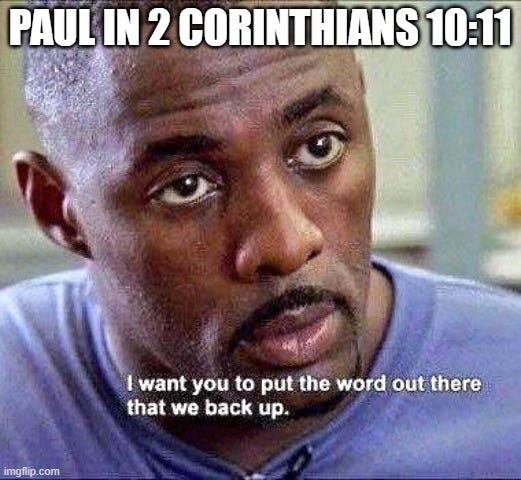
2 Corinthians 10:11 represents the rare time in which the Scripture correlates to a meme:
Let such a person consider this: What we say by letters when we are absent, we also are in actions when we are present (2 Corinthians 10:11).
Bible Readings for May 04-10, 2026
Acts Reading: Acts 17:22-31
Paul preached to the Athenians on Areopagus. Paul had perceived how religious the Athenians were, for he observed their altar “to the unknown God.” Paul then proclaimed this God to them as the Creator of all things, Lord of heaven and earth, and one who does not dwell in manmade temples. He does not need anything from humanity, for He has given everything life and breath. He made all nations out of one man and has determined their seasons and boundaries. Mankind was created to seek God, yet He is not far from them, for in Him they live, move, and have their being (a quotation from the Cretica of Epimenides), and we are His offspring (a quotation from the Phainomena of Aratus). If humanity is God’s offspring, then God would not look like a metal image of human creation. God had overlooked their ignorance, but now called on all men to repent, for He had appointed a day on which He would judge the world through the Man ordained to this task. The judgment is made certain by the resurrection of this Man from the dead.
What can we gain from Paul’s preaching in Athens?
The Psalm: Psalm 66:8-20
David thanked God for His provision and faithfulness. David called upon the nations to praise God. God kept His people alive. God tested His people and purified them like silver; His people experienced suffering and distress from enemies, but He preserved many. David would perform the vows he made in the day of trouble. David invited all the faithful to hear what God did for him. He cried out and praised God. If David had kept sin in his heart, YHWH would not have listened to him. God heard his prayer; God was worthy of praise, for He did not reject David’s prayer or forsake His covenant loyalty toward him.
Why should we entrust ourselves to God and His faithfulness?
Gospel Reading: John 14:15-21
Jesus would not abandon His disciples after His death and resurrection. Jesus declared to the eleven that if they loved Him they would keep His commandments. Jesus would pray to the Father, and He would provide the Paraclete, the Comforter/Advocate, the Spirit of truth, who would abide with them forever. The world cannot receive the Spirit; it does not know Him or perceive Him, but He abides with Jesus’ disciples. Jesus would not leave them desolate. In a little while the world would no longer see Him, but His disciples would see Him; because Jesus lived, His disciples would live. They would then know Jesus is in the Father, they would be in the Son, and the Son would be in them. The one who has and keeps Jesus’ commands loves Him; the one who loves Jesus is loved by the Father, and Jesus would love him or her, and manifest Himself to him or her.
How has God manifest Himself to us?
New Testament Reading: 1 Peter 3:13-22
Peter continued to strengthen the Christians of Asia Minor to remain faithful to Jesus despite suffering. Peter asked who would harm the Christians if they were zealous for what is good; even if they would suffer for the sake of righteousness, they should not be troubled, but sanctify Jesus in their hearts, making a defense for the hope in them with gentleness and courtesy. Christians ought to have a good conscience so that those who would malign them would be put to shame. It is better to suffer for doing good than for doing evil on account of the example of Jesus. He suffered once for sin to bring the unrighteous to God; He was put to death in the flesh, but made alive in the Spirit. Jesus went to preach to the spirits in prison, those disobedient beforehand, as in the days of Noah, when few were saved over water. Baptism, the antitype to what happened in the Flood, now saved Christians: not removal of dirt but the appeal of a good conscience toward God through the resurrection of Jesus. Jesus is at the right hand of God in heaven; angels, authorities, and powers are subject to Him.
Why should Christians trust in God despite persecution?

This week’s cat tax is a reminder to get some rest. Bucky will show you how.
At some point, yes, book reviews will return. I’m looking forward, in fact, to getting back into a better book reading rhythm.
Thanks as always for your interest, prayers, and support.
May the peace and grace of our Lord Jesus Christ be with your spirits.
Ethan